Monday, October 15, 2007

In case you're wondering, they're chewy and slimy, like little black eyeballs.


Reader, I’ll tell you a secret. I’m not sure I like Kathleen Berry. Well, okay, it’s a love-hate relationship. At times while reading her essay, from Chapter 1 of The Great White North, I found myself whole-heartedly cheering her on. At other times, I was confused to the point of annoyance. I think I will be better able to articulate the essence of my disagreement with, or misunderstanding of, Berry after the class discussion and some extra reading on my part. Maybe a few more cups of coffee will do it. For now, though, I will respond to her concluding questions about Whiteness, privilege, and how we might recognize and fight against the institutionalized and systemic bias in favor of Whiteness that exists in Canadian society. (I want to say that on this point, I agree with Berry entirely that racism still exists, and that it is a problem that should be recognized and addressed.)

And so let us recognize it. Berry asks the readers at the end of her essay to identify ways in which Whiteness has entered their lives in Canada as either privilege and/or oppression. This is at once a very easy, and a very difficult task to address. As a White Canadian, I am aware that my ethnicity does indeed afford me privileges, but this awareness is mostly abstract. It is not specific; it is not personal. There are only a few incidents in my life in which I can recall being privileged because I am White, or being discriminated against because I am White. I will give an example of both types of experience here, and then discuss the issue of Whiteness in a more abstract way.

As I suspect is the case with most people, I recognize my own privilege almost exclusively when I realize the disadvantages of someone who is not White. I remember dating a Mohawk boy in grade six, and my mother was disgusted that I’d associate myself with someone "from the reservation" (in fact, Steven lived two streets over in a bigger house than ours). I remember being stricken by the unfairness of my mother’s distaste for someone because of his race. Was this how the teachers at school thought about him? After that, I was hawkish when watching how Steven was treated by the faculty and staff, ready to pounce on anyone who gave him so much as a dirty look (it was my way of compensating, of course, for the fact that I was too cowardly to pounce on my mother).

But incidents like the one above have been few and far between in my life. Similarly, I have few personal experiences with being the target of racial prejudice. One rather pathetic example happened when I was sixteen and I was at a friend’s birthday party in Mississauga. Every other girl there was either Asian or Black. This, compounded with the fact that I didn’t know any of them, made me feel more than a little conspicuous. When they asked me if I wanted to go with them to get ‘Bubble-Tea,’ and I admitted that I had no idea what they were talking about, one girl laughed and said, "You’re really White, aren’t you?" I shrugged and asked her how she'd managed to figure that one out. Was it the white skin, or the utter lameness of me that gave it away?

That night, I forced down the vile mixture of milk, tea and tapioca balls as if it were a magic elixir that could exculpate me of my Whiteness. When I returned to Montreal, I found a place that sold Bubble-Tea and made a habit of drinking it often, drinking it in public, and telling everyone how great it was. Eventually I developed a taste for it, but it didn’t matter because around that time that I decided to stop drinking it on principle.

Now, I warned you that the example was pathetic! You see now, Reader, the paucity of real experience with prejudice from which I have to draw when trying to imagine what being the victim of racism must be like. I can only say that recently, by virtue of my writing on current events for the purposes of this blog, I have become more aware of the racism and xenophobia that is rampant in Quebec and Canadian culture. It has left me surprised, disillusioned, and eager to effect change. About a month ago, I mused that perhaps my envy of my peers’ cultural distinctiveness had "blinded me to the possibility that this distinctiveness might be a target of bigotry." I can now say that most certainly this is the case. Ironically, the invisibility of my race, which is what perpetuated my feelings of what I called ‘cultural impoverishment,’ is also the mechanism through which the bias in favour of Whiteness propagates.

This suggests to me that not only does the invisibility of Whiteness affect minorities negatively, but it is also detrimental to White identity. Often, there is no racial self-examination for the White Canadian. There is no identity moratorium of a cultural dimension, which, I think, cheapens White identity as something to be taken for granted. Therefore, while it is a privilege not to be labeled as "other" and not to be the object of bigotry, the absence of any critically-achieved cultural identity can also be oppressive to the soul. At least, I think it has been for mine.

In a related question, Barry asks her readers to consider ways in which they, their students and their families and can work to articulate and transform the authority of Whiteness at the individual, societal, community and institutional levels of Canada. I feel very strongly that the articulation must precede the transformation. This blog, our class discussions, our discussions around the dinner table with friends and family, our voices in more public places will be essential to shaping the future of this nation. We must talk amongst ourselves, and then we must talk to those who disagree with us – letters to newspapers, letters to MPs, and public debate are essential.

Although I take issue with many of the opinions being expressed at the Bouchard-Taylor hearings, I think that this kind of public forum is a valuable part of the dialogue. Their website includes a survey you can take to express how you feel about reasonable accomodation in this province. The commission is still hearing statements from the public - you can see their schedule here.

As a citizen, I feel compelled to stay informed and to participate in the conversation - passionately, vocally, and with conviction. As a teacher, however, my philosophy is somewhat different. That is, I do not think it is appropriate to place emphasis on racial issues in a science classroom. This is not to say that a discussion about racial issues isn't important, but only that these issues are not to be debated at the expense of a child's scientific literacy.

When I teach science, I will pay homage to the contributions of White scientists when White scientists deserve the credit, Black scientists when Black scientists deserve the credit, and Chinese scientists when Chinese scientists deserve the credit, and so on. I will point out relevant examples of where racism and sexism have manifested themselves in the history of science. In short, I will teach my subject fairly. I will treat all my students fairly and with sensitivity to their cultural backgrounds. I will not tolerate racism in my classroom. I will not tolerate anything that compromises the academic quality of the class I teach. The way I see it, the best thing I can do for my Minority students is exactly the same as the best thing I can do for my White students: teach them good science.


Be it resolved that... this blog entry is clearly cataloged as a response to Fox's advice, Chapter 8


As a science teacher, I do not intend to engage my classes in discussions about race, racism, and identity. Indeed, as I read the assigned chapter of Helen Fox’s book, When Race Breaks Out, I found myself envious of my peers who will one day be teaching English and Social Sciences to high school students. I am envious not only because the exercises in Fox’s book seem especially relevant for students who are reading To Kill a Mocking Bird, or who are studying the internment of Japanese Canadians during the Second World War, but also because the subject of race and racism in Canada is a fascinating topic to discuss with young people and unfortunately, my subject does not lend itself to this kind of conversation.*

I console myself with the knowledge that there is always the debate team (that is, if I can wrench the coaching responsibilities away from whomever is lucky enough to have them). I was a high school debater and I loved it. I loved it even though, when I found myself at the national debating seminar, the resolution before us was Be it Resolved That Forestry Will Determine This Country’s Future, and I had to argue about the economics of softwood lumber for two weeks. (In the small Ontarian town of Thunder Bay, where the seminar was held, the ups and downs of the forestry industry were front page news.)

All this to say that Fox’s exercises in media analysis and developing anti-racist arguments really spoke to me. This quotation from a Latina undergraduate made me want to stand up and cheer, yes!
I like that you stress knowing facts. No one can fight you when you know better than they do. I’ve noticed a difference in my ability to communicate more concisely and convincingly. I feel like I’ve got a few missiles in my arsenal. (129)

Yes, yes! I love the idea of empowering students with militant ideas. Let them be intellectual terrorists! Let them take no prisoners! Let them learn to debate with each other respectfully and passionately! This is exactly the sort of activity I had in mind when I wrote about teachers having a positive impact on our national dialogue (see October 12th).

And now that I’ve used my entire exclamation mark quota for the day, I'll describe the one of Fox’s activities that I would most like to discuss, and that is the exercise in media analysis. This choice might seem at odds with my excitement about using debating techniques to help students explore racial issues, but I think that being able to analyze media critically and thoughtfully is a prerequisite to good debate. So much of what we know, or think we know about ethnic minorities comes from the media, and if we are not responsible consumers of that information, then we are truly lost.

Fox recommends presenting students with newspaper articles and challenging them to find biases in the reporting. That is, are certain perspectives left out? Are certain religious or cultural groups stereotyped? I would add the questions, How are you able to make that judgment – how do you “know better”? Do you think the bias is intentional or malicious? Who is the reporter and what are his motivations?

This exercise would not only help students to recognize racism, but it would also encourage them to adopt an attitude of skepticism when they read newspapers and watch television. I think this activity would be particularly powerful when done in conjunction with the magazine analysis, where students discuss the differences in how ethnic minorities are represented in the mainstream media and how they are represented in media written for and by their own ethnic communities. This would not only reinforce the exercise in identifying prejudices, but also encourage students to seek variety in their news sources. The group discussions that result from the media analysis can then be used as a launching pad for any of Fox’s activities for developing anti-racist arguments.

There are few disadvantages to these kind of exercises - I would argue that the ability to think critically about what one reads is among the most important skills a student can learn. It’s a passport for understanding the world. That being said, there are some shortcomings of the above activities, if they are done in isolation, and if one’s purpose is to bring students to a heightened sensibility about racial issues.

That is, the media analysis exercises are largely impersonal. Unlike the discussion topics which require students to examine their own racial identity, their own prejudices and the prejudices that others have against them, the object of critique in the media analysis exercises is an outside party. The student may come to a better understanding of the systemic racism that in prevalent in society and in certain groups, but this is easily divorced from the student’s personal experience. If good media analysis is a passport for understanding the world, the student must also have a passport for understanding himself. The latter is better accomplished by an exercise that examines the student directly.


* In fact, the history of science is filled with examples of racism and sexism. When the science teacher talks about famous experiments and the people who designed them - Einstein, Curie, Bohr, Franklin and the rest - putting these characters into the proper historical context can help make them more real to the students. Particularly for students who feel they are at a disadvantage because of their ethnicity, discussing examples of famous minority scientists might make them more optimistic about their own prospects in science. I think these kinds of discussions would be a small but worthwhile addition to any science curriculum.


Sunday, October 14, 2007

Is there an echo in here?


Macleans.ca is running a feature about the breakdown of Canadian tolerance. It's a wonderful piece, paralleling many of my thoughts and concerns exactly. One note of caution: the article is dated October 22, 2007 - next Monday- so you might get stuck in a TIME WARP when you click that link. (Just when you thought I'd forgotten about the musicals... *snigger*)

Also worth reading from Maclean's is this article about Turkish women who forgo a university education because they cannot wear the hijab on campus. This is a brilliant example of why secularism is not a shortcut to social equity, no matter how you spin it.

Friday, October 12, 2007

Is a "cultural mosaic" what we really want, or is that just a poetic analogy we use to make ourselves feel better?


So, did you all stay up to watch the Ontario election? Yeah, me neither. I suspect few people bothered to stay tuned to hear about the easily-predicted victory of Dalton McGuinty, who didn’t even have to break a sweat to win a second mandate with a majority government. His success is being largely attributed to opponent John Tory’s hugely unpopular position in favor of public funding for religious schools.


Grade Two students dribble during gym class at the Our Children Our Hope ISNA
Elementary School in Mississauga, September 12, 2007. Photo credit: Steve Russell


As a Quebecer who has been keeping track of the current debate on reasonable accommodation, I cannot help but opine that Ontario’s argument about funding faith-based schools is about more than government-subsidized religious instruction. I think the results speak to the heart of how Ontarians in particular, and Canadians in general, think a multicultural society should operate. And can you believe it? Turns out, we don’t really want to live in Trudeau’s cultural mosaic after all.

A recent SES poll finds that 53 percent of Canadians feel that immigrants should “fully adapt” to the Canadian way of life. In Quebec, 77 percent responded that immigrants should adapt to Quebec and Canadian society. Interestingly, support for reasonable accommodation is weakest in the provinces which are accepting the largest number of newcomers. A separate Léger Marketing poll done exclusively in Quebec shows the opposite trend – that is, support for reasonable accommodation is weakest in the eastern part of the province where people have less contact with minorities. The poll also found that younger Quebecers tend to be the most willing to accommodate religious minorities on certain issues.

From the Montreal Gazette, commenting on the poll:

Why the generation gap? Two reasons, said Sirma Bilge, an assistant professor of sociology at Université de Montréal who has studied the question.

“The younger generation has first-hand experience of diversity,” she said. “And they did not live through the Quiet Revolution. So they tend less to worship French-style secularism and feel less anxious about religious diversity and immigration.”

Young people are also more familiar with minorities in their daily lives - through personal contact, through the media and the Internet, through popular music and travel. Almost half of all 18-to-24-year-olds - 46 per cent - said they're often or occasionally in contact with Muslims, for example. That's three times more than the likelihood among over-65s, only 15 per cent of whom have contact.

“For the young generation, seeing a woman wearing the hijab is no big deal - it's part of the landscape, it's part of diversity,” said Patrice Brodeur, a Harvard-educated religion expert who teaches in Montreal. “And they're asking themselves ‘What's the big fuss?’”

This is exactly the question that I’ve been asking myself lately: What’s the big fuss? The news coverage of the Bouchard-Taylor Commission has left me reeling. Recently, the Quebec Council for the Status of Women has called for an outright ban on all “visible” religious symbols in public institutions (interestingly, the Council feels that a crucifix on a necklace is not “visible” enough to give offense, but hijabs, turbans and yarmulkes will have to go). This same group has called upon the government to amend the Quebec Charter so that women’s rights usurp religious freedoms, and Jean Charest seems amenable to the change.

Now, one could argue that Charest has little recourse but to pander to the worst - and most popular - side of the debate. Since the Hérouxville Manifesto of Intolerance and the ADQ’s sudden rise from obscurity, Charest has been trying to give his party a more nationalist flavor without alienating his Liberal base. Indeed, the appointment of the Bouchard-Taylor Commission can be seen, at worst, as a maneuver by Charest to pass the reasonable accommodation hot-potato during a precarious election season. But then again, perhaps a painfully frank discussion is what this province needs right now, and there can be absolutely no question that the discussion is frank.

What I’m wondering is if we are having the right discussions. Is the issue of frosted windows at the YMCA to accommodate orthodox Jews, or prayer spaces in public places to accommodate Muslims, or Sikh men wearing turbans while they work their RCMP beats really what’s got this province so upset? Are the citizens of Hérouxville really afraid that Muslim families are going to move in and start stoning their wives and daughters to death in the town square?

I suspect not. Goodness, I hope not. I think these issues are just the most visible and easily-sensationalized fronts of a much more abstract battle about values. The equality of men and women is a Canadian value. Democracy and free speech are Canadian values. Increasingly, people would like to consider secularism as a Canadian value as well, though this seems to be at odds with our proclaimed commitment to multiculturalism. We cannot pretend to be open to other cultures and then ask our Jewish doctors to remove their yarmulkes. It just doesn’t work that way.

But I think that in the majority of cases, it’s possible for us to find a way of accommodating religious minorities without compromising our values. What is needed is real leadership from our government, not constant political pandering to whichever side of the argument is biggest and loudest. We also must demand more responsible coverage from our news media, which is wont to sensationalize trivial conflicts in the interests of turning a profit. We need to have a serious discussion about the real issues – not about what people wear on their heads, but about what people believe in their hearts. We need to have an understanding of what the clothing truly signifies before we can make a judgment about whether or not these symbols threaten our way of life. We need to address the fears and misconceptions we have about social segregation and religious extremism before we can take fair and wise steps towards averting these threats to our social peace and national security. At last, we must have a definition of what multiculturalism truly means in Canada.

This conversation will happen in our media, in our communities – in our schools. As teachers, I think we will be in a privileged position to influence the dialogue, not by telling our students how we think the world should work, but by giving them an education they can use to form their own, informed opinions. This is why education is essential to democracy, to peace, and to liberty. And, this is one of the reasons I want to be a teacher.

Monday, October 8, 2007

Diversity worth $12, 870 to some parents…


The New York Times ran an interesting weekend article about parents seeking diversity in their children’s educational experiences. Says a mother whose three-year-old is attending two expensive foreign-language schools, “People who start their children on a language so young understand it’s a multicultural world and they want their children to be part of it.”

The article also discusses the difficulty African-American families face in choosing a school district which offers high-quality schools with a diverse student body. It’s worth a look!

I just got it, on the third shot of espresso!


It’s been a tiring two weeks. True, I’ve been sleeping until noon while the rest of you engage the enemy (I mean, ahem… go off on practicum), but you must understand that my guilt over the whole thing has exhausted me completely. That must be why it took me a few cups of coffee and several replays to appreciate this campaign ad for the Green Party of Ontario.


Get it? ‘Grey’ is Progressive Conservative. But he reminds me of ‘PC’ from the Apple ads! One abbreviation…two different guys… but they’re both squares! Yuk, yuk, yuk! Who says Canadian politics can’t be fun!?

Alright, so what am I on about? Well, there is a provincial election in Ontario on October 10th, and the place of religion in public schools has become an important issue for voters. Should faith-based schools be eligible to receive public funds, providing they adhere to the Ontario curriculum and hire licensed teachers? The aptly-named John Tory, leader of the Progressive Conservatives, says aye. Frank de Jong, leader of the Greens, says nay. And the Liberal incumbent Dalton McGuinty seems content with the status quo, which is a terribly awkward mixture of his opponents’ positions. That is, presently in Ontario, the only religious schools which receive public funding are Catholic schools.

As those of us enjoying the Policy Course know, the funding of the Catholic schools is protected under our Constitution, which in 1867 assured all pre-existing religious schools the right to continue in this tradition. In fact, in 1997 when Quebec sought to reorganize its school boards by classifying them linguistically rather than denominationally, the government had to petition Ottawa for a constitutional amendment allowing for the dissolution of the Protestant and Catholic boards. Newfoundland also asked for and received such an exemption in 1998 so that it could abolish its denominational school system. Today, Ontario is the only province in Canada which continues to fund its Catholic schools to the exclusion of other faiths; every other province either funds all religious schools equally or funds none of them.

The question of how to correct this apparent injustice is not a new one for Ontarians. In 1984, after a decision to extend even more funding to the Roman Catholic high schools, Premier Bill Davis appointed a commission to investigate whether the province’s other faith-based schools should receive public funding. After an extensive one-year study, the commissioner Bernard Shapiro presented a report which suggested that the government extend some public assistance to the private schools, and he included recommendations on how to execute this plan. (As an interesting aside, Shapiro would later become Principal of McGill University, from 1994 to 2002.)

It is perhaps unfortunate that the Ontario government did not act on these recommendations. In 1999, the United Nations Human rights Committee ruled that Ontario’s policy of funding only the Catholic schools is discriminatory, in violation of the International Covenant on Civil and Political Rights, which Canada ratified with the consent of all provinces, in 1976. In 2005 the committee censured Canada yet again, for failing to "adopt steps in order to eliminate discrimination on the basis of religion in the funding of schools in Ontario."

What humiliation! Clearly, something must be done. But what? Should the province withdraw public support from the Catholic schools in order to create one public, secular system (as is the case in New Brunswick, Nova Scotia, Prince Edward Island and Newfoundland)? Or should the province extend partial or full funding to all religious schools (as is the case in Quebec, Alberta, British Columbia, Saskatchewan and Manitoba)?

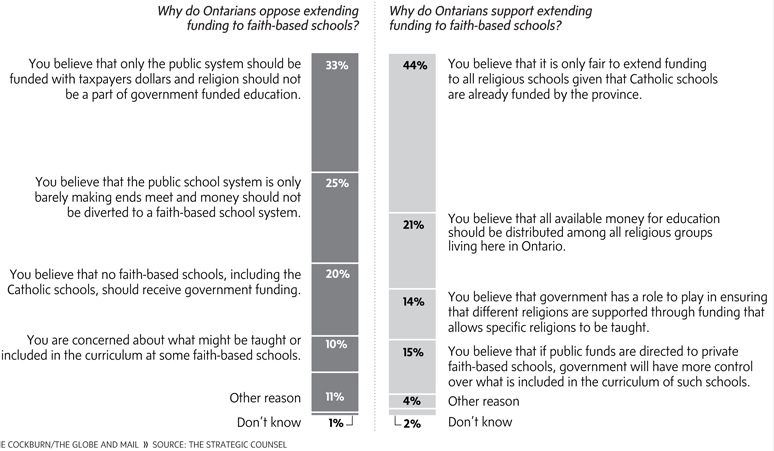
If anything, Ontarians are leaning towards the latter. This poll reports that 71% of those surveyed oppose the funding of faith-based schools. An especially helpful component of the poll was a breakdown of the reasons for which the respondents answered the way they did (click for larger image):


Of the reasons for opposing faith-based education, I find the spending priority argument to be the least convincing. That is, if religious schools are deserving of public funds, they are deserving of them whether or not those funds are scarce. If there is a burden to be borne, let it be borne equitably, or else let us fund the schools properly.

More interesting to me is the argument that in principle, religion should not be a part of public education and therefore should not be a taxpayer expense. Of course, by funding faith-based schools the taxpayers would not be paying for religious indoctrination in its own right, but rather for an education adhering to the guidelines of the provincial curriculum, being taught in a religious environment. Let us make that very clear; it is an important distinction. Still, mixing religion with taxpayer dollars tends to put people on edge. For instance, when I brought this topic up in conversation a friend of mine scowled and declared, "Separation of Church and State!"

As a self-labelled Godless Liberal, I liked the sound of that. I still like the sound of it, even though I don’t think it works in this context. Canada adopts a policy of religious pluralism, not atheism. If we are to accept that religion is an integral component of culture, and if we embrace a philosophy of multiculturalism (using the Canadian Multiculturalism Act as our guide to building a society cohesive with this philosophy), then does it not follow that we should recognize and support the religious traditions of our communities? Doesn’t imposing secular education on every child (that is, on every child whose parents can’t afford to pay upwards of $600 per month in tuition) contradict our deepest convictions about the value of diversity?

I find these questions very compelling. We expect our government to promote multiculturalism – it is one of the defining ideas of our nation. But to deprive the public educational system of unique schools, diverse schools, specialized schools and yes, secular schools as well (for it is essential to have the correct balance) is I think, to deprive our society of an enormous opportunity for richness and equity.

There is an interesting counterargument, however, which deserves some attention. To wit, a secular school system is essential for a multicultural society to function well. The secular schools provide a common touchstone for a diversity of citizens, giving children of different backgrounds and beliefs a common experience. This commonality and familiarity, presumably, fosters tolerance, and certainly we must recognize that tolerance is of paramount importance. If it is true, as Dalton McGuinty suggests in his campaign video, that funding the religious schools would result in the kind of segregation that would harm the social cohesion of the very multicultural society we wish to propagate, then Tory’s plan must be viewed with great reticence.


But in truth, I do not find McGuinty’s argument entirely convincing. Right now about 30% of Ontario students attend publicly-funded Catholic schools. Has this caused so much damage that the 2% of students who currently attend schools of another religion cannot be accommodated? Surely, Montreal is one of the best examples of a successful multicultural society, and this city has the highest percentage of private schools in North America (in Quebec, the figure is 30%; on the island, it is much higher). I hypothesize that the status-quo is more detrimental to Ontario’s multicultural mosaic than any alternative could be. The blaring unfairness of funding only the Catholic schools probably breeds resentment on the part of minority groups, and rightly so!

In the following video, John Tory makes the argument that the opportunity to receive public funding would act as an incentive to faith-based schools to teach the Ontario curriculum. It is a good point. Right now there are 53, 000 students attending private, faith-based schools with little or no government oversight. Would it not be better to encourage these schools to adopt the standards of education that all other Ontarian students enjoy?


It is possible that my position on this issue is influenced by my own history of having been educated in a Catholic secondary school. I can say with conviction that I did not experience any feelings of segregation. On the contrary, I found the experience culturally enriching. Though, I do not credit the doctrines of Catholicism with the excellence of my schooling; I credit the teachers entirely, and the sense of community and spirit of charity that the faith indirectly encouraged in The Girls. I know some of my former classmates who were much more enriched spiritually than I was. I know others who didn’t like the atmosphere at all, and transferred to another school.

You see, it is not my position that a religious education is preferable to a secular one. What I do believe that it is right to give parents and students the choice. I think that we can have a public school system that is as diverse as the society it seeks to educate, and that there is more than one way to educate a child to the academic standards that Ontario requires of its secular schools. I think that all schools who achieve this standard of academic instruction should be eligible to join the public education community.

To me, this is a very Canadian idea. That is, in my Canada, it is not enough to promote multiculturalism in secular schools while in the same breath imposing that same kind of secularism on everyone who wants a public education. In my Canada, a religiously-minded family does not have to choose between financial security and giving their child an education that reinforces their culture and values. In my Canada, multiculturalism is not whatever results from pooling all the students together into one type of learning environment and calling it “equality,” even if that learning environment is ill-suited for some of those students. Rather, multiculturalism in my Canada flourishes naturally because of public policy that promotes strong communities of diverse citizens who feel welcomed and valued. This is the kind of welcome that fosters patriotism for a new home - or in my case, for an old one. This is the kind of welcome that I would be proud to extend, as a Canadian, to all those who want to be Canadians, too.